Space Exploration Technologies Corp. (SPCX): Investment Memo

Thank you for reading this post, don't forget to subscribe!
Disclaimer: This infographic and accompanying content are for informational and educational purposes only. They do not constitute financial advice, an investment recommendation, or an offer to buy/sell any securities. Always conduct your own research or consult a licensed financial advisor before making investment decisions.
Investment Thesis
Space Exploration Technologies Corp. (Nasdaq: SPCX), commonly known as SpaceX, is one of the most ambitious technology companies in the world. Founded in 2002 by Elon Musk, the company operates at the intersection of aerospace, satellite communications, defense technology, and space infrastructure. Its mission is to reduce the cost of access to space and ultimately enable human settlement on Mars.
Following its landmark IPO in June 2026, SpaceX entered public markets as one of the most valuable companies globally, giving investors direct exposure to a business that combines high-growth communications services with long-term space exploration opportunities. The company priced its IPO at $135 per share, raising approximately $75 billion in what became the largest IPO in history.
Core Growth Engines
SpaceX’s growth is driven by three major business segments.
First, the company dominates orbital launch services through its reusable Falcon 9 and Falcon Heavy rockets. Reusability has transformed launch economics and enabled SpaceX to capture a significant share of both commercial and government launch markets.
Second, Starlink has become the company’s primary commercial growth engine. The satellite internet constellation serves customers worldwide and provides recurring subscription revenue, diversifying SpaceX away from the cyclical launch business.
Third, Starship represents the company’s long-term strategic platform. Designed for missions to the Moon, Mars, and deep space, Starship could unlock entirely new markets, including lunar logistics, in-space manufacturing, and eventually interplanetary transportation.
Key Risks
Despite its strengths, SpaceX faces substantial risks.
The company operates in a capital-intensive industry where delays, launch failures, or regulatory setbacks could materially affect growth. Starship development remains technologically challenging and requires enormous investment.
Additionally, SpaceX trades at an exceptionally high valuation following its IPO, meaning future returns will depend not only on operational success but also on the company’s ability to meet extremely ambitious growth expectations. Competition from traditional aerospace firms, emerging launch companies, and global satellite operators also remains intense.
Bull vs. Bear Case
Bull Case
The bullish investment thesis for SpaceX rests on the company’s leadership across multiple high-growth markets. Starlink could evolve into one of the world’s largest satellite broadband networks, generating substantial recurring cash flows. Meanwhile, Falcon rockets continue to dominate global launch activity, and Starship has the potential to open entirely new industries, including lunar logistics, space-based manufacturing, and interplanetary transportation.
Supporters argue that SpaceX is not simply an aerospace company but rather a platform business with exposure to telecommunications, defense, artificial intelligence infrastructure, and the emerging space economy. If the company successfully executes on its long-term vision, today’s valuation could prove justified.
Bear Case
The bearish case centers on execution risk and valuation. SpaceX operates in an industry where technical failures, launch accidents, or regulatory restrictions can have significant financial consequences. Starship remains an unproven commercial platform and may require years of additional investment before generating meaningful returns.
Furthermore, expectations embedded in the company’s market valuation are extremely high. Slower Starlink subscriber growth, increased competition, or delays in major programs could lead investors to reassess SpaceX’s long-term growth trajectory. Critics also argue that many of the company’s most ambitious goals, including large-scale Mars colonization, remain speculative and may not translate into shareholder value for decades.
Long-Term View
For long-term investors, SpaceX represents a unique opportunity: exposure to a company that is simultaneously a launch provider, a global telecommunications network, and a pioneer of the emerging space economy.
If management successfully scales Starlink, commercializes Starship, and maintains its leadership in reusable launch technology, SpaceX could become one of the defining industrial and technology companies of the 21st century. However, investors should expect significant volatility and recognize that much of the company’s future value depends on executing projects that remain unprecedented in scale and complexity.
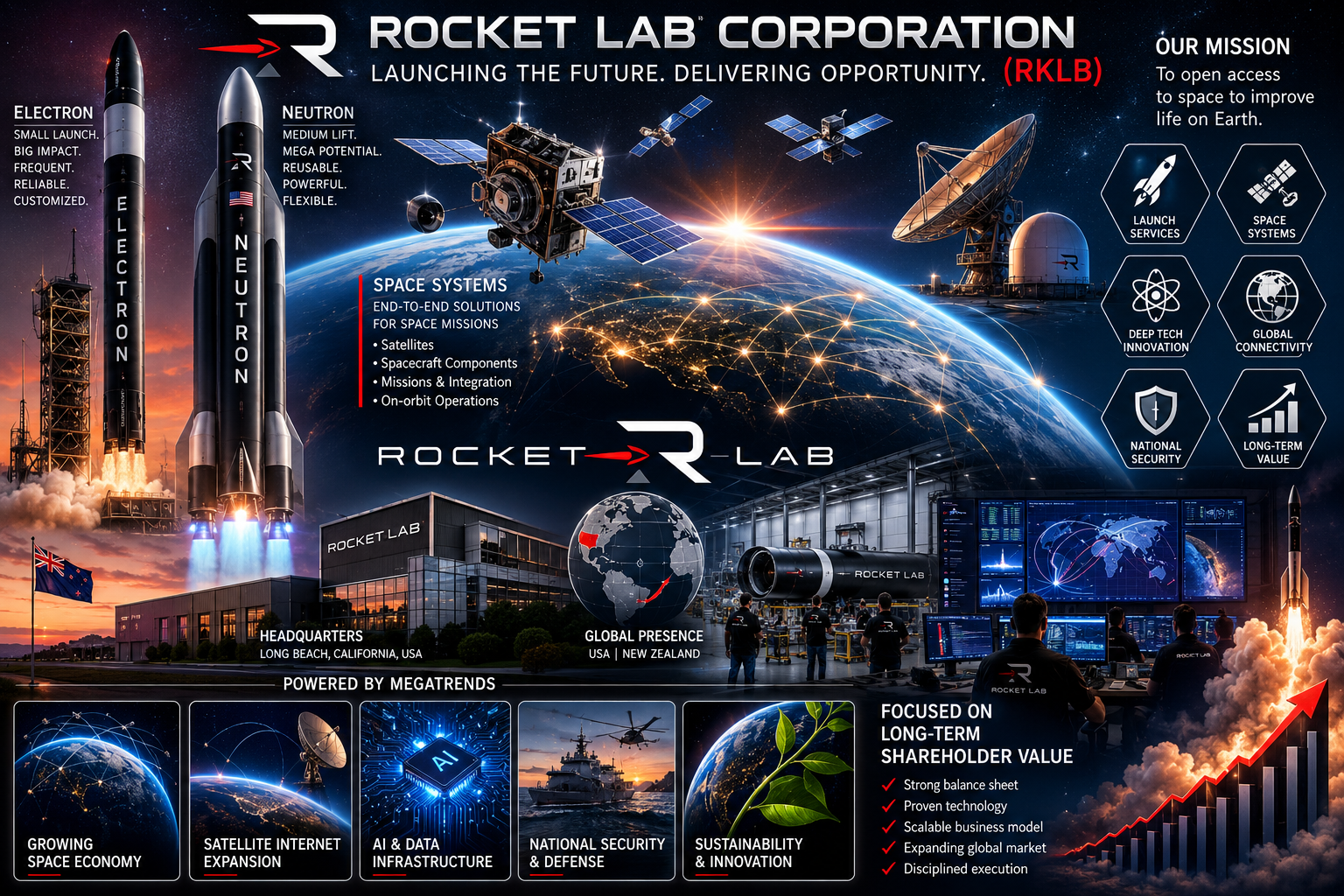
Rocket Lab Corporation (RKLB): Investment Memo
Disclaimer: This infographic and accompanying content are for informational and educational purposes only. They do not constitute financial advice, an investment recommendation, or an offer to buy/sell any securities. Always conduct your own research or consult a licensed financial advisor before making investment decisions.
Share this:

Discover more from The Finance Compass
Subscribe to get the latest posts sent to your email.