GE Vernova Inc. (GEV): Outlook on Core Growth Engines, Emerging Risks, Bull vs Bear Case, and Long-Term Investor Value

Thank you for reading this post, don't forget to subscribe!
*Disclaimer: This content is for informational and educational purposes only and does not constitute financial, investment, or trading advice. Stock markets involve risk, and past performance is not indicative of future results. Always conduct your own research or consult a licensed financial advisor before making investment decisions.
Introduction
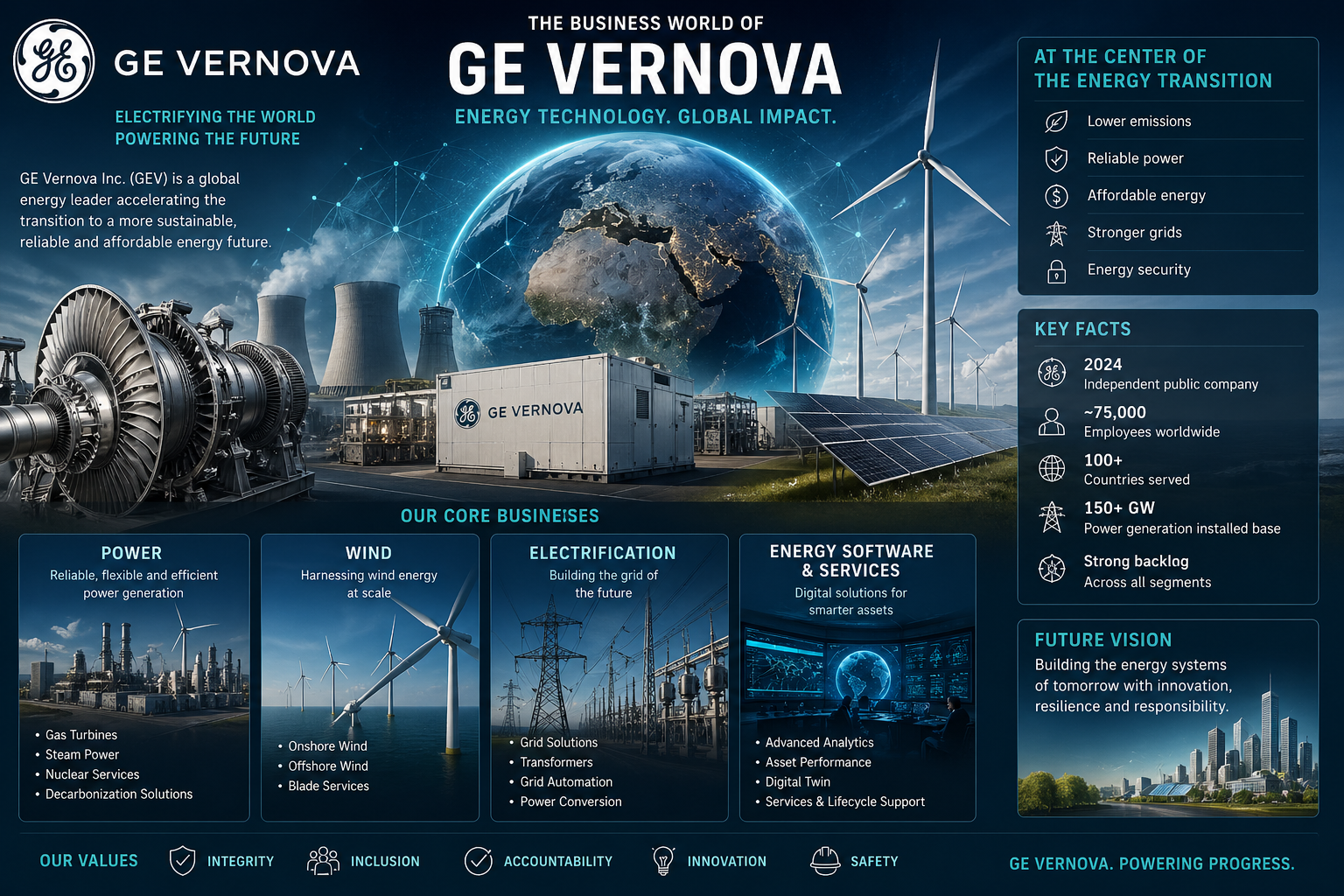
GE Vernova Inc. is a newly independent global energy infrastructure company formed after the restructuring of General Electric in 2024. It focuses on power generation, grid modernization, and electrification technologies at a time when global electricity demand is accelerating due to artificial intelligence, industrial expansion, and energy transition policies.
Its strategic positioning places it at the center of one of the most important macroeconomic trends of the next decade: the global electrification supercycle.
(Related context: AI-driven energy demand and infrastructure shifts discussed in broader market analysis: AI Stocks Deep Dive Series -> AI Infrastructure vs Product)
Core Growth Engines
1. Global Electrification and AI Power Demand
GE Vernova benefits directly from rising global electricity consumption driven by AI data centers, cloud computing infrastructure, and industrial electrification. This structural demand increase is forcing utilities and governments to invest heavily in new generation capacity and grid upgrades.
2. Gas Turbine Leadership
The company remains a leading global provider of advanced gas turbines, which serve as critical “bridge energy” technology during the transition toward lower-carbon systems. Gas turbines provide dispatchable power that stabilizes grids when renewable generation is intermittent.
3. Grid Infrastructure Expansion
A major long-term growth engine is GE Vernova’s electrification segment, which includes transmission systems, transformers, and grid automation technologies. Aging infrastructure in the U.S. and Europe requires multi-decade investment cycles.
(Related context on global market infrastructure trends: Global Market Trends 2025: Key Analysis and Insights for Investors)
4. Renewable Energy Exposure
The company also operates in wind energy, including onshore and offshore turbine systems. While this segment has faced profitability challenges, long-term policy support for decarbonization continues to provide structural demand.
Emerging Risks
1. Wind Energy Profitability Pressure
The wind segment remains the most challenging part of GE Vernova’s portfolio due to cost inflation, project delays, and competitive pricing pressure. Persistent underperformance could weigh on overall margins.
2. Execution Risk Post-Separation
As a newly independent company, GE Vernova must demonstrate operational consistency, margin improvement, and effective capital allocation after its spin-off from General Electric.
3. Cyclical Exposure
Parts of the business are tied to utility and industrial capital expenditure cycles, which can fluctuate with macroeconomic conditions and interest rate environments.
4. Competitive Landscape
The company competes globally with firms such as Siemens Energy (XETRA – Germany) and Mitsubishi Heavy Industries (Tokyo Stock Exchange – Japan), creating ongoing pricing and technological competition across multiple segments.
(Related context on industrial competition and energy transition dynamics: Bull vs Bear Case: Comparative Risk Assessment)
Bull Case
The bullish investment thesis for GE Vernova is grounded in three structural trends:
1. Electricity Supercycle
Global electricity demand is entering a long-term expansion phase driven by AI, electrification, and industrial modernization.
2. Infrastructure Replacement Cycle
Developed economies must replace aging power grids and expand transmission capacity, creating sustained multi-decade demand.
3. Multi-Segment Exposure
GE Vernova benefits from diversified exposure to gas, grid, and renewables, allowing it to capture value across different stages of the energy transition.
Bear Case
The bearish scenario highlights several structural and operational risks:
1. Weak Wind Economics
Continued underperformance in wind energy could drag down consolidated profitability.
2. Slower Margin Expansion
If restructuring efforts fail to significantly improve operating efficiency, earnings growth could remain muted.
3. Competitive Pressure
Global energy infrastructure markets remain highly competitive, potentially limiting pricing power.
Long-Term Investor Value
GE Vernova represents a hybrid investment profile between industrial infrastructure and long-duration energy transition exposure. It is not a high-growth technology disruptor, but rather a foundational energy systems provider.
Its long-term value depends on:
- Successful execution of operational restructuring
- Sustained growth in electricity demand
- Stabilization of wind energy performance
- Continued global investment in grid modernization
From a portfolio perspective, GE Vernova functions as a long-duration infrastructure compounder aligned with electrification megatrends.
(Broader context on long-term energy investment strategies: AI Stocks Deep Dive Series -> Financial Risks in AI Companies)
Conclusion
GE Vernova stands at the intersection of global electrification, AI-driven energy demand, and infrastructure renewal. While it carries meaningful execution and cyclical risks, its exposure to structural demand growth positions it as a potentially significant long-term beneficiary of the global energy transition.
The company’s investment appeal lies not in short-term disruption, but in its role as a critical enabler of the world’s evolving power system.
*Disclaimer: This content is for informational and educational purposes only and does not constitute financial, investment, or trading advice. Stock markets involve risk, and past performance is not indicative of future results. Always conduct your own research or consult a licensed financial advisor before making investment decisions.
Share this:

Discover more from The Finance Compass
Subscribe to get the latest posts sent to your email.