Astera Labs, Inc. (ALAB): Outlook on Core Growth Engines, Emerging Risks, Bull vs Bear Case, and Long-Term Investor Value

Thank you for reading this post, don't forget to subscribe!
*Disclaimer: This article is for informational and educational purposes only and does not constitute investment advice, financial advice, or a recommendation to buy or sell any securities. Investing in stocks and semiconductor companies involves risk, including possible loss of principal. Investors should conduct their own research and consult a qualified financial advisor before making investment decisions.
The artificial intelligence infrastructure race has fundamentally changed the semiconductor industry. As hyperscalers, cloud providers, and enterprise customers continue investing heavily in AI servers and accelerated computing systems, the market increasingly depends not only on raw GPU power, but also on the connectivity infrastructure enabling massive volumes of data movement between processors, memory, and accelerators.
Within this rapidly evolving ecosystem, Astera Labs, Inc. has emerged as one of the newer public companies positioned at the center of AI connectivity and cloud-scale infrastructure optimization. Similar to broader themes explored across The Finance Compass coverage of AI infrastructure, semiconductor cycles, and long-term technology investing, Astera Labs represents both a high-growth opportunity and a company exposed to substantial execution and valuation risks.
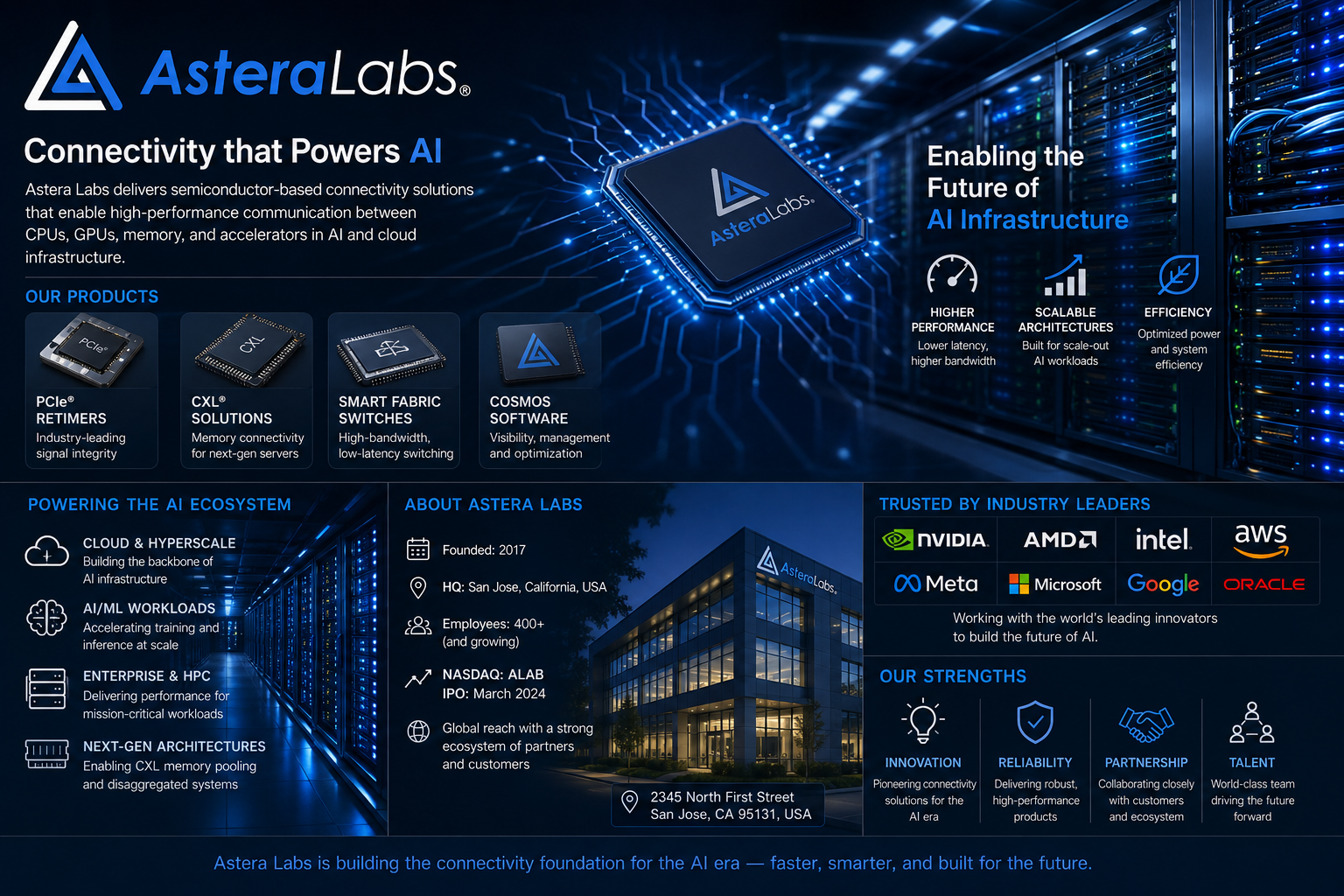
The company develops semiconductor connectivity solutions designed for AI servers and cloud data centers, including PCIe retimers, CXL-based memory connectivity systems, and intelligent fabric technologies. Rather than competing directly with GPU leaders such as NVIDIA Corporation, Astera Labs operates within the critical interconnect layer surrounding AI compute infrastructure.
This infrastructure-centric positioning resembles broader themes discussed in articles such as NVIDIA Corporation (NVDA): Outlook on Core Growth Engines, Emerging Risks, Bull vs Bear Case, and Long-Term Investor Value, where system-level AI scaling increasingly matters as much as compute performance itself.
AI Infrastructure as the Primary Growth Engine
The most important long-term driver for Astera Labs is the global expansion of AI infrastructure spending. Modern AI clusters require enormous bandwidth and increasingly sophisticated communication architectures between GPUs, CPUs, memory pools, and accelerators.
As explored in AI Stocks Deep Dive Series -> AI Infrastructure vs Product, infrastructure providers may benefit from the overall growth of AI adoption regardless of which software or model providers ultimately dominate the market.
Astera Labs benefits directly from several structural trends:
- higher GPU density inside AI servers,
- rising memory bandwidth requirements,
- increasingly complex server architectures,
- and the need for lower-latency communication across large-scale AI clusters.
The company’s products help address bottlenecks that emerge when thousands of accelerators operate simultaneously within hyperscale AI environments.
This broader AI infrastructure expansion also aligns with trends discussed in Super Micro Computer, Inc. (SMCI): Outlook on Core Growth Engines, Emerging Risks, Bull vs Bear Case, and Long-Term Investor Value, where server architecture and AI hardware integration increasingly shape competitive positioning.
The Strategic Importance of CXL and Advanced Connectivity
One of Astera Labs’ potentially most significant long-term opportunities lies in the growing adoption of Compute Express Link (CXL), an emerging industry standard designed to improve memory sharing and communication efficiency between processors and accelerators.
As AI models continue growing larger and more memory-intensive, future data-center architectures may rely heavily on pooled memory systems and advanced interconnect standards.
This transition reflects wider semiconductor industry themes discussed in Inside TSMC’s 2025 Outlook: Growth Drivers, Competitive Risks & Long-Term Value, where next-generation chip ecosystems increasingly depend on integration, packaging efficiency, bandwidth optimization, and system-level engineering.
If CXL adoption accelerates globally, Astera Labs could occupy an increasingly important position within AI infrastructure supply chains.
Competitive Risks and Industry Pressures
Despite its promising growth profile, Astera Labs also faces several material risks.
The semiconductor industry remains intensely competitive, particularly in high-growth AI infrastructure markets. Larger players such as Broadcom Inc., Marvell Technology, Inc., Intel Corporation, and Advanced Micro Devices, Inc. possess substantial engineering resources, customer relationships, and vertical integration capabilities.
Many of these competitive dynamics resemble concerns explored in Marvell Technology, Inc. (MRVL): Outlook on Core Growth Engines, Emerging Risks, Bull vs Bear Case, and Long-Term Investor Value, where AI-related growth opportunities coexist with cyclical semiconductor risks and aggressive competitive pressure.
Another key concern involves customer concentration. Large hyperscalers often represent enormous revenue opportunities, but they also possess strong bargaining power and can rapidly alter procurement strategies or infrastructure spending priorities.
The semiconductor sector has historically experienced cycles of overinvestment followed by inventory corrections and demand slowdowns. If AI infrastructure spending eventually normalizes after the current boom, smaller high-growth infrastructure suppliers may experience sharp revenue volatility.
These broader cyclical concerns were similarly addressed in Micron Technology, Inc. (MU): Outlook on Core Growth Engines, Emerging Risks, Bull vs Bear Case, and Long-Term Investor Value, where AI optimism must be balanced against historical semiconductor boom-and-bust cycles.
Bull Case vs Bear Case
The Bull Case
Supporters of the bullish thesis argue that Astera Labs operates in one of the most strategically important segments of the AI economy.
The primary bullish arguments include:
- AI infrastructure spending could remain elevated for years,
- connectivity complexity continues increasing,
- CXL adoption may create major new market opportunities,
- and system-level optimization is becoming essential for future AI scaling.
Bullish investors may also view Astera Labs as a relatively diversified AI infrastructure play because the company’s technologies support multiple compute ecosystems rather than relying exclusively on one GPU vendor.
This investment framework overlaps with themes discussed in AI Stocks Deep Dive Series -> AI Competitive Landscape, where infrastructure-layer companies may benefit from broader AI adoption across the entire industry.
The Bear Case
Bearish investors remain concerned that market expectations may already price in extremely optimistic growth assumptions.
The primary bearish concerns include:
- AI infrastructure spending eventually slowing,
- aggressive competition from larger semiconductor firms,
- margin pressure from hyperscaler customers,
- and the risk of valuation compression if growth decelerates.
The market has already demonstrated that high-growth AI stocks can experience substantial volatility when expectations shift. Young semiconductor companies often face particularly sharp price swings because future growth assumptions heavily influence valuations.
Similar valuation-related risks were discussed in Nasdaq 100 Mar 26 (NQ=F): Outlook on Core Growth Engines, Emerging Risks, Bull vs Bear Case, and Long-Term Investor Value, especially regarding concentration risk and elevated AI-related market sentiment.
Long-Term Investor Value Perspective
From a long-term perspective, Astera Labs represents a company positioned within a critical layer of next-generation AI infrastructure.
Its future success will likely depend on several factors:
- whether AI infrastructure demand remains structurally strong,
- how rapidly CXL and advanced interconnect standards are adopted,
- whether the company can maintain technological differentiation,
- and how effectively it competes against much larger semiconductor rivals.
The company also reflects broader long-term themes explored in Global Market Trends 2025: Key Analysis and Insights for Investors, where AI infrastructure, semiconductor innovation, cloud-scale computing, and digital transformation increasingly shape the future global economy.
Ultimately, Astera Labs may become an important long-term beneficiary of the global AI buildout if demand for high-performance connectivity infrastructure continues expanding. However, investors should also recognize that the semiconductor industry remains cyclical, competitive, and highly sensitive to changing market expectations.
For long-term investors, the company therefore represents both significant upside potential and substantial execution risk – characteristics that increasingly define many emerging leaders in the modern AI infrastructure ecosystem.
*Disclaimer: This article is for informational and educational purposes only and does not constitute investment advice, financial advice, or a recommendation to buy or sell any securities. Investing in stocks and semiconductor companies involves risk, including possible loss of principal. Investors should conduct their own research and consult a qualified financial advisor before making investment decisions.
Share this:

Discover more from The Finance Compass
Subscribe to get the latest posts sent to your email.